Monday, December 10, 2007

December 2007 Middle Vaal Report

Dirk Human with one of his hand reared Smallmouth – he feeds them too much.


Occasionally a non-fisherman would comment on a trip that was less “successful” in terms of numbers of fish caught, saying: “that was a long distance to travel for 3 fish!” How do you explain to such a person that there is so much more to our pursuit than just the actual catching of fish? Yes it is magnificent when you do get a new record number or that big one, but surely there are more ingredients to the Bouillabaisse than just fish.

Preparing for trips must be a ritual that all of us partake in – invariably starting with a visit to your favourite fly shop, buying new gear (new C&F medium box for Sterkies) or tying various new or old successful flies. I always tie flies before a big trip even if my fly boxes are full, it gets me into the right frame of mind. That’s why I end up with so many unused patterns. I’m tying for Sterkfontein at the moment, enjoying the paradigm shift between the Vaal and Sterkies although we are fishing for the same species. Time to get out the #14 and smaller hooks as anything on a #10 looks gigantic.

Water and Weather forecast

This must be one of the wettest summers we’ve had in a couple of seasons. Keith it’s almost like in the UK, rain every day, I’m thinking of getting a brolly. It would be advisable to monitor the dam release as well as the Barrage reservoir release before venturing to the river. Some of the lodges like Elgro can give you accurate reports on the visibility.

For those remaining at home or visiting the Middle Vaal during the holidays the medium term forecast is for warmer and drier conditions. That should give you ample opportunity to explore the river.

Insect Activity

It is mid summer, the predominate hatches will be caddis – small dark brown to tan al the way to the big Vaal caddis. With the lower visibility you may have to concentrate your efforts subsurface where the larva can be imitated with everything form natural latex to the various shades of the green for the Vaal caddis.

Mayfly hatches occur, mostly late afternoon into the night. Once it starts getting dark I find a big attractor dry to be a better option than matching the hatch. The fish are very aggressive and will take anything that lands on the water. Nymphs can still be imitated with GRHE and darker brown/black patterns. If you are into imitative tying have a look at the clinging mayfly naturals, there are some distinct features to build into your patterns.

Black fly should be present on most days, remember to add a good quality insect repellent. This is one instance where going eco-friendly is not going to cut it, treat the inside of your shirt as well as your skin.

Approach and Technique

The different styles of Czech nymphing would be the bread and butter technique when the flows do pick up. With lower summer viz you’ll have the benefit of being less visible to the fish as long as you adopt a careful noiseless wading style. This style of fishing can give you the edge when the flows are up at 25-30 cumecs.
There is obviously still place for regular nymphing and the other techniques discussed in these reports.
Black coloured flies do give better contrast in low visibility and don’t forget to try one of the many bloodworm imitations. Changes in flows wash these residents of the muddy substrate into the main current.

LARGEMOUTH

Summer is not traditionally a great time to target these fish but they obviously still feed. You can try fishing a large crab pattern while targeting smallies. You’ll be surprised how many smallies you pick up with the benefit of offering a more substantial meal to suite the appetite of a big largie. My first largie of over 70cm was caught on a crab pattern, in the rapids in February.

Another option is to wait until sunset and then to target the tail outs of large pools with big bulky flies – either surface or sub surface. I’ve seen big largies move into the shallower water, one memorable fish at Wag ‘n Bietjie effortlessly popped a 2X tippet. Best to go 1X or even 0X and have more than memories.

If any of you catch a largemouth please send us a brief email with the following details:
· Fly, size, colour.
· Date, time.
· Area, general, no need to divulge secret spots.
· Tactics, line, depth, retrieve.

This should benefit fellow anglers and could also provide valuable information to the conservation and research people.

NEWS

My holiday did not produce the fishing opportunities dreamed up in preparation of the trip. Instead we unfortunately witnessed the severe flooding and extensive damage and loss experienced by the people of the Western Cape. I did get 4 small Garrick on a Flipper it’s a good fly that – certainly one I will adopt for Largies.

FOSAF recognised the contribution we make and sent me the latest edition of Favourite Flies (Keith it’s in the library) – great book with interesting contributions from great fly fisherman around the country.
I found a dead Cape Gannet on the beach which was ringed (dead ringer?). A quick Google put me in touch with the avian demography unit at UCT http://www.birds.sanbi.org/safring/safring.php. or safring@adu.uct.ac.za or safring@gmail.com
If you do find or see ringed birds and can get the ring number please forward to them, they certainly do respond and appreciate the feedback.

Cheers
Carl

Monday, November 05, 2007

November 2007 Middle Vaal Report

It’s not easy turning out these reports with something new and interesting every month. I occasionally read through the back copies of the reports and they contain a multitude of information on catching the two Vaal river yellowfish species, in all conditions bar the 1300 cumecs we had in April 2006. We have covered all the angles in these reports and I believe there is scope to explore various new alternatives going forward.

Keith sent me a link on Spiders not these http://www.sexyloops.co.uk/cgi-bin/theboard_07/ikonboard.cgi?act=ST;f=4;t=3034;st=1980 rather this http://www.spidersplus.co.uk/home.html. I thought the man’s gone all traditional, he’s lived in the UK for 10 months and he is already becoming a crusty Brit. Soon we’ll see photo’s of him in tweeds, tie and deerstalker on a chalk stream or heaven forbid leaving a pub in an English rugby sweater. Not! Keith’s always been the thinker and, innovator. If it wasn’t for that one article of him and Garth in TCFF I would most probably still be pursuing only trout on fly. There is nothing wrong with trout, it’s just that I live in a province with summer temps around the mid 30’s, which is not conducive to happy Salmonidae.

Water and Weather forecast

It seems as though this half of summer will be fairly normal as far as Highveld summers go. We’ve had good rains across the area and the Vaal dam is already at 70%. It would be advisable to monitor the dam release as well as the Barrage reservoir release before venturing to the river.

Afternoon thunder storms are a typical feature of summer, I may sound like a typical father figure but working for a mining company I’ve had exposure to the methodology of safety systems and understanding why people get killed. It would be prudent to take head of the threat the accompanying lighting strikes do pose for us on the river. There is no 2nd chance no life time guarantee - get off the water in time!

Insect Activity

I was privileged to be invited to partake in the Northern Cape Bells and met some very interesting fly fisherman and whiskey (apologies Derek) drinkers. It was great to fish different water to what we call home. The aquatic insect life was different, I saw no sign of the Vaal caddis (Hydropsychidae) and most rocks had 75% mayfly nymphs on them.


The area had a lot of spirogyra (rocksnot etc) so Czech nymphing was frustrating. But I managed to get a few fish by swinging a team of flies in the deeper sections. This diving caddis produced two in quick succession - http://www.danica.com/flytier/steps/diving_cdcelk/diving_cdcelk.htm

The best moment of the trip was Saturday evening catching a smallmouth on dry with the lions roaring their greeting at the encroaching darkness.

I can recommend a visit to Nkolo and the Northern Cape waters, with the right planning around the flows etc you will experience the magic of a different Vaal river. You may even be rewarded with some big smallies and in winter excellent largemouth. Believe me I saw the photo’s in Jacques Marais’s presentation, they make you very-very envious.

Approach and Technique
Yellows eat mulberries floating on the surface, tie up some patterns!

If you’ve been fishing for as long as I have you get to a stage in your fly fishing career when it’s not just about the fish and the quantity you catch. A good friend of mine, Zoran eluded to the stages of fly fishing in his front page http://www.sexyloops.com/2007.shtml?1026 . These philosophical prophecies are usually brought on by the wisdom of age or when you blank on the water. I have experienced it, it is a humbling experience and very necessary. If it was all too easy we would not grow as Fly Fishers. I certainly take stock after such an event and revaluate my options – throw money at the problem, new fly, new materials etc.

There certainly is opportunity to try these different techniques on the Vaal. Be it now or when the seasons change, bringing on more challenging conditions for the traditional Vaal techniques. People would say that to consistently catch smallies you have to get down in the zone with big heavy bombs – that’s the only way. Yeah right like catching trout consistently on a Mrs Simpson and sinking line - it works but is it really fun? Don’t get me wrong I’m not advocating that these techniques are the purist form of fly fishing and that anything else is akin to coarse fishing.
Don’t go to the river and frustrate yourself to a stage where you’re not enjoying it anymore. The point of our pursuit is still to catch fish and release them unharmed back into their environment. I’m just asking you to get out there and experiment to broaden your horizon.

A good large-scale yellow caught in stillwater - small peacock bugger

LARGEMOUTH

There aren’t a lot of new fly patterns developed these days, most are just variations of tried and tested patterns. Sometimes you come across a pattern that just begs: “Take me for a swim in Largie infested water!” The meat-wagon certainly does have most elements I would want in a Largemouth fly - bulk, movement, flash. I’m tying some on SS hooks for the small leeries of Swartvlei and the smallmouth bass.

http://www.wayupstream.com/2007/10/meat-wagon.html

I received 2 emails for the Largiebase. I believe there are more successful fisherman out there, they either believe in the conspiracy theory (of us trying to steal their secret spot) or don’t have access to email ;-)
If any of you catch a largemouth please send us a brief email with the following details:
· Fly, size, colour.
· Date, time.
· Area, general, no need to divulge secret spots.
· Tactics, line, depth, retrieve.

This should benefit fellow anglers and could also provide valuable information to the conservation and research people.

NEWS

I’m off to the Knysna area and will give the Gouritz a go when I’m down there. I may be able to teach those “illegal” Smallmouths to eat a dry fly or 2. On the way down there, I’ll be fishing a mystery dam in the Free State – hopefully the water is clear and the fish are head up and feeding.


Cheers
Carl & Keith
carl.yellowfever@gmail.com
keith@yellowsonfly.com
http://yellowsonfly.blogspot.com/

Tuesday, October 02, 2007

October 2007 Middle Vaal Update

October 2007 Middle Vaal Report

I’m doing a presentation at the Northern Cape Bells, on the threats facing our yellowfish. A quick bit of research on the internet revealed a multitude of major threats facing trout and therefore by deduction yellowfish. There are loads of information available on US rivers and lakes – the typical problems we experience are not limited to South Africa.

Water and Weather forecast

Summer has come and gone, we have spring and a normal season again. The rain was very welcome especially for the farmers, but I’m sure a good flush of the river will help the fishing. Although these days we’re not so sure what is flushing into the river.

The flow data available here http://www.reservoir.co.za/flow.htm would assist when planning a trip but watch the rainfall figures for the Barrage catchment area. That is everything south of the mountains you drive through on the N1. Water clarity has dropped due to the rain to about 30-50 cm.

With respect to temperatures during the week in question, it seems likely that somewhat elevated temperatures should continue to persist in the northern interior but maximum temperatures over the remainder of the country more or less normal for this time of the year.
In terms of rainfall, several upper troughs moves across the country during this outlook period an rainfall probability remain good for the central and eastern parts of the country. www.weathersa.co.za

Insect Activity

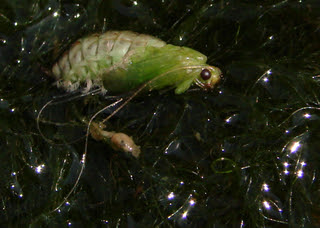
I spent the long weekend fishing the Parys area and managed to get a few photos of the food items on the Vaal menu. Apologies for the quality but macro photography doesn’t work from a bobbing boat. Email me if you want the better quality photo’s.

2 stages of Hydropsychidae


The same pupa removed from the larval shuck


Note the key triggers – black eyes, long antennae and gills


Adult Hydropsychidae – those wings are almost 2/3 of the body.


Brown damsel nymph

There are a lot of the Vaal caddis about. I have watched the adults, they certainly don’t present an easy meal when in flight touching the water occasionally. I believe a reasonable imitation of the emerging pupa above and of course the larva will be your best bet. That said I did get 2 good fish over 5lb on the now famous Hydrolater. There are also hatches of small 16-18 chocolate and black caddis.

The summer mayfly hatches will be interspersed with the caddis, size and colour of the adults should be covered by generic patterns – nymphs are predominately brown to black and adults cream to black.

Approach and Technique

As already mentioned I got two fish on the dry. I’m at that stage of my fishing where 2 fish on a dry makes my day and I’m a content fisherman – and I didn’t get anything else on the upstream nymphing or CZ nymphing. The latter 2 methods will certainly be your bread and butter techniques for the rest of summer. You will only rarely be afforded the opportunity to fish dry or dry & dropper.

Heres some advice for those of you looking for something different to lobbing heavy control flies around. The guys at Midcurrent has this interesting extract from Ed’s book. “This week we offer Ed's advice on freestyle nymphing with small flies that is, nymphing without split shot or indicators. As Ed notes, choosing your casting position, fishing a short, drag-free line, and having a keen eye for potential takes are all essential ingredients. http://www.midcurrent.com/articles/books/engle_smallflies.aspx
ED ENGLE'S home water is the South Platte River in Colorado, where he guides and instructs fly fishers on the finer points of fishing tiny flies to overstuffed and finicky rainbows and browns. Not surprisingly, he is a recognized expert on the subject, and in the past three years he's penned two books on the subject of small flies and trout.”
There certainly is a case for fishing small nymphs especially if you have a look at the naturals underneath a rock in the river.

LARGEMOUTH

To date we have not received any reports of largemouth caught – I assume you are all bum fly fishers who cannot catch any. If any of you catch a largemouth please send us a brief email with the following details:
· Fly, size, colour.
· Date, time.
· Area, general, no need to divulge secret spots.
· Tactics, line, depth, retrieve.

This should benefit fellow anglers and could also provide valuable information to the conservation and research people.

NEWS

I walked past this critter. Please be on the look out for snakes when walking outside the river. This night adder (identified by the black V on the head) is poisonous but you are unlikely to die from the bite.


Cheers
Carl & Keith
carl.yellowfever@gmail.com
keith@yellowsonfly.com

Friday, September 14, 2007

Vaal Flows : 14-16 September

There were rumours going around of release flows from the Barrage of 60 cumecs planned for the weekend. Randwater confirmed the plan is to maintain it at 15 cumecs.

Wednesday, September 05, 2007

September 2007 Middle Vaal Report


Summer is just around the corner and for many flyfishers the hiatus is over. But it’s also the time of the year when our beloved yellowfish spawn. Please take the time to read through Keith’s excellent advice
http://www.fosaf.co.za/fosafs/images/Wading%20impact%20Wallington.doc.

We do have an impact but must try to keep it to a minimum. There really is no achievement in catching huge quantities of spawning adults. Send us an email if you do see fish spawning.

And please send us photographs of people targeting spawning fish... we'll post the images on a "name and shame blog"

Water and Weather forecast

I don’t know about the weather in your area but on this side of the Magalies mountains winter has vaporised in the +30C day time temperatures. The normal summer fishing conditions that bring the crowds back to the Vaal is around the corner. The gamble the next few weeks would be to get the inevitable cold front during the week with warm pleasant weather over the weekends.

The water temperature at the Barrage is +/- 14C, this is at 7am, so depending where you are fishing in the Dome you will get water that’s above 16C in the afternoon. This may be sufficient to bring the smallies right up or into the rapids – but more on that later.

The flow data available here http://www.reservoir.co.za/flow.htm will be accurate and sufficient to plan a trip until the summer rains come. Water clarity is still good at around 100cm.

Bad news at this stage for those people living off the land is that the rainfall forecast is below average for September. So that’s just about every one of us as Woolies get their food off the land as well.


Insect Activity

Reports coming in from the weekend indicate that the compound insect hatches have started.

At this stage the caddis are small, #14-16 light brown adults (Elk Hair Caddis, Kaufmann’s stimulator), subsurface these would be represented by tan/cream larvae. Get ready for the appearance of the large Vaal caddis, don’t arrive without the range of patterns to imitate them. The larvae spend all winter fattening up to a size 10 even 8 hook. http://www.yellowsonfly.com/Fly_Patterns.html

The summer mayfly hatches will be interspersed with the caddis, size and colour of the adults will vary, but a friend had great success on an Adams recently. Unless you are a prodigious flytyer who enjoy tying different colour variations of the patterns it will be safe to take the generic patterns readily available in the shops – nymphs are predominately brown to black and adults cream to black.

The hatches will last much later in the afternoon, even after sunset. You’ll have enough time to fish the hatch and drive back for the 22:00 kick off of the World Cup matches – before inevitably falling asleep in a one sided Bokke vs USA mismatch.

The blackfly are out as well, “Peaceful Sleep” helps for the adults, these help for the larvae http://www.yellowsonfly.com/Fly_Patterns__Other.html .

Approach and Technique

We still have a window of opportunity for some good dry fly fishing to sighted fish. The fish have not entered the rapids yet, but should be congregated just below them. This area can be very productive during hatches, as all the cripples and other easy meals end up here. It’s like drive-thru with the cars parked and the burgers floating to the windows.

Fishing a dry as indicator can make your day so much more interesting. I’ve had evenings on the Vaal with fish hitting a Hydrolater, in a blanket hatch of mayfly and small caddis. Phew what more do you want??? The larger flies are certainly easier to follow in the low light.

This time of the year the algae (http://en.wikipedia.org/wiki/Spirogyra) becomes a serious problem on the Vaal. It has always been there, but it is particularly bad in places. This is due to the increase in nutrients (untreated sewerage, fertilizer and feedlots on the river banks) coupled with the clarity allowing more sunlight to penetrate. Reports from Bothaville area is that the rapids are unfishable. If your approach is limited to the conventional summer nymphing tactics you are in for a very frustrating day. My suggestion is:
• Investigate different venues and also areas at the same venue. The growth of algae and other vegetation varies in severity along the Middle Vaal.
• As mentioned earlier the fish will be poised to move up into the fast broken water. Target them in the eye or throat of the pools just below the rapid were the water is deeper. A dry & dropper drifted in the channels between the algae and water grass will limit foul ups. Up your tippet to 3X to give you the ability to turn fish away from the thick grass.
• If you have access to a boat prospect until you find fish actively feeding. There are still pods of fish holding in water too deep for any vegetation to grow. You can target these with long casts (to avoid spooking them) and a dry & dropper rig.

MidCurrent has compiled a list of 42 Fly Fishing Strategy Tips have a look through them in preparation for the summer trips. http://rs6.net/tn.jsp?t=8jwwzdcab.0.5hcy9dcab.9qa5g8n6.2806&ts=S0272&p=http%3A%2F%2Fwww.midcurrent.com%2Farticles%2Ftips%2Ftips_strategy.aspx

LARGEMOUTH

To date we have not received any reports of largemouth caught – I assume you are all bum fly fishers who cannot catch any. If any of you catch a largemouth please send us a brief email with the following details:
• Fly, size, colour.
• Date, time.
• Area, general, no need to divulge secret spots.
• Tactics, line, depth, retrieve.

This should benefit fellow anglers and could also provide valuable information to the conservation and research people.

NEWS

The Northern Cape Bells festival will be held at Nkolo Spa from 4 to 7 October. It’s a great venue and the event is always well organised. More info can be found here:
Drie Provinsies Vlieghengel Klub & Northern Cape Yellowfish Working Group
http://flyfish.kimvertise.co.za/

I have received isolated reports and photo’s of injured fish, please be on the look out for yellows with injuries and send us a brief email with details even photo’s. On the other hand a friend fished below Parys on the weekend and he reported fat good conditioned fish that put up a serious fight!

I found this bit of disturbing news on the Reservoir site.

Scientist Warns of Typhoid Time-Bomb
At one point the Franschhoek sewerage works linked to the Berg River were running at 200% capacity but without any chlorine for two months "someone forgot to order it". In June, the Wellington municipality dumped "an enormous heap" from a bucket latrine system onto the banks of the Berg River. Barnes took water samples from the river nearby and found an E. coli count of 216 000. The E.coli bacterium is used as an international standard to measure water pollution. The European Union standard for avoiding contact with water when it is polluted is just 1 000 E.coli to 100ml of water, while South Africa's standard the responsibility of the Department of Water Affairs and Forestry is 2000. "I notified all the authorities possible. Nothing was done." Referring to a Boland township, Barnes said a sewer there had overflowed for six months. "I couldn't get the municipality to come in and clean it up they said they couldn't find it. But the school was just nearby and every child coming to school went right past it. Also, it was running straight into a water course." Despite this year's extremely good rainfall, Barnes has found E. coli counts in the Berg River that were way over the safety standard.

Our rainy season is about to start and this threat will again rear its ugly head. Please report incidents to us or use the Water Crime link on the FOSAF site.


On a lighter note….


Cheers
Carl & Keith
carl.yellowfever@gmail.com
keith@yellowsonfly.com

Friday, August 03, 2007

MIDDLE VAAL RIVER UPDATE AUGUST 2007


Flat clear and calm


WATER AND WEATHER FORECAST

August is the windy month, frontal systems will carry remnants of the Southeaster which will test the ability of a 5 weight and your perseverance. In fact wind will be a factor on most days, adapt and use the wind to your advantage – the ripple will give cover against observant yellows in clear water. Staying away from the river because of wind, would be like the All Blacks not touring because Schalk is playing. Day time temperatures are slowly increasing and the peach

blossoms are out in the Magaliesberg.

www.weathersa.co.za

The water temperature at the Barrage is doing its utmost to breach the 10 degree mark, almost in the range were the Capies would take to the water at Clifton in December. I fished the Parys area 3 weekends ago without waders, if you don’t enter the water or fish after sunset waders aren’t essential.

Flows are constant at what I would assume to be the winter reserve flow: providing for low and very clear water.

INSECT ACTIVITY

Mayflies are the dominant emerging insects. Be on the lookout for drifting nymphs, emerging adults or the returned spent adults. Try to spot the adult naturals and imitate them - colours range from cream to black, combined with a dark brown or hare’s ear nymph you should cover the surface and sub-surface cycle. The mayflies hatch anytime during the day but the best time is between 10am to 3pm.

APPROACH AND TECHNIQUE

Drifting a team of nymphs

There is one aspect of fishing for yellows on the Vaal which is extremely frustrating but keeps me coming back for more. Those days when I don’t catch anything, blank, zip, no takes no knocks just nothing. Three weeks ago we fished the Parys area on an absolutely perfect Saturday; apart from the fact that the All Blacks gave us another clap. There was little to no wind, the flow was right and the visibility up to 2 meters. There was a good hatch of #14 Mayfly
coming off, but no regular feeders. The best I could do for the day was photographing this porcupine feeding on an island.

The next day was another absolute beauty. I dropped into a few venues and walked the bank looking for action. The whole pool at Dimalachite was void of any rises or cruising fish. I decided to turn back and head to the previous day’s venue, at least we had seen some movement there.

Fishing deep on an intermediate line, I picked up the first fish 30 minutes into the session on a squirrel Zonker nymph (tungsten bead). The line was left to drift through the deepest part of the pool and then retrieved as the flies approached the base of a rocky outcrop. The fish took on the retrieve.


I moved on; upstream to a bigger pool with a rocky ledge that affords a great vantage point over the tail-out. I spotted a good 7lb fish in the tail-out but not much else in the pool or along the ledge. By the way I stuffed up by throwing the weighted zonker to the fish in the tail out, I should have switched to a smaller weighted nymph.

I worked the rest of the pool all the way to the head, just below the rapid. The swallows were feeding on hatching Mayfly (#14 brown) in the rapid which was a good sign but the fish stayed down. I allowed the current to take me into an eddy and then I spotted pods of 5-10 fish
cruising lazily; 30cm below the surface. I switched to a brown CDC emerger with an unweighted nymph on the dropper, which they refused. I tried everything in the C&F box, stepped down on the tippet, super sized the meal to a large foam beetle – nothing!

In hindsight I should have tried ultra small flies (#18's maybe). The tactic might work but the only way of knowing is to go back to the river and try that. If you find those flies or hooks too small, try tying smaller nymphs on bigger hooks like these demi-nymphs http://www.danica.com/flytier/bharang/bwo_demi_nymph.htm .

LARGEMOUTH

I’ve had very little success this winter but Grant got this solid fish in the Parys area.

"Fast retrieve, fished deep, fished close to edge/structure, big flashy fly".

I’ve heard good reports of decent largies taken in the Northern Cape, one of 7kg, unfortunately not on fly.

Keith suggested we get a largemouth catch database going.

This should benefit fellow anglers and could also provide valuable information to the conservation and research people in time when we have built up enough data.

If any of you catch a largemouth please send us a brief email with the following details:

  • Dimensions (fork length, girth) and notes on condition
  • Fly, size, colour
  • Date, time.
  • Area, general, no need to divulge secret spots.
  • Tactics, line, depth, retrieve.
  • Photographs
  • Weather conditions

NEWS

The Proceedings of the Yellowfish Working Group Conference is available on the FOSAF website. A word of thanks to Peter Arderne who edited the document.

Melissa Brand is from the University of Johannesburg, undertaking a study which is aimed at determining the social and economic value of the yellowfish in the Vaal River as a targeted angling species. If we can prove that this resource has a value then the Government will support the industry by managing the Vaal River. Please visit the website and complete the questionnaire. The students at UJ (see Linda Nel’s telemetry study on the same website) are doing valuable work to raise the status of yellowfish as a flagship species. What is a Flagship species? Think Black rhino, the general public, NGOs and Government can identify with a rhino better than the Lessor Spotted Tree Toad. Once the rhino reserve is proclaimed and funded, the above mentioned LSTT will benefit as well.

Our UK correspondent (at large) has recently been published on one of Fly Tying’s premier websites - http://www.danica.com/flytier/kwallington/kwallington.htm This site has an absolute treasure of fly patterns and ideas for the fly tier, many which can be used or adapted for our beloved yellowfish.

Cheers

Carl (& Keith)

Thursday, July 05, 2007

JULY 2007 Middle Vaal report

A crisp clear morning on the Vaal


Water and Weather forecast


Technically speaking summer is on the way, the daylight units are increasing although the temperatures are certainly not. It is still damn cold even on this side of the Magalies. The key to success is to fish the weekend following a few days of mild temperatures - in the low 20’s. The forces of nature don’t always coincide with our schedule of Saturday and Sunday fishing, so take leave in the week. You want to avoid fishing with an approaching frontal system over the Southern parts of the country.

As we approach August the incidences of windy days increase. Excessive wind is always a problem for the fly fisherman, whether it’s 6 guys in a small cabin or the force of nature making life hell on the water. It makes casting harder, reduces the visibility, stops insects hatching and creates windknots (not my casting). The graph below is for the town of Potchefstroom, but should be a good indication of conditions on the water. The timing would vary but bargain on having wind from 10 am to 3 pm. Prime fishing time.


http://www.weathersa.co.za/


The flow rates are down to a constant 11 cumecs (23-29 June) a perfect rate for winter fishing. No data available from the Barrage at the moment. Clarity still varies but in general it is great – over 100cm in most areas.

Insect Activity

Mayflies are the dominant emerging insects. Be on the lookout for drifting nymphs, emerging adults or the returned spent adults. Try to spot the adult naturals and imitate them - colours range from cream to black, combined with a dark brown or hare’s ear nymph you should cover the surface and sub-surface cycle. The mayflies hatch anytime during the day but the best time being 10 am to 3 pm (Predominately windy!?).

Approach and Technique

My last trip out was to Elgro lodge, we fished in fairly high flows of +30 cumecs (peak of 70). This made for tough fishing and easy paddling. Clarity wasn’t great and the fish were unsettled by the unseasonal flows. The first fish we found were holding over rocky flats in the large pools, but these weren’t keen to take the fly. It was late afternoon before we spotted the first consistent surface feeders. I took my first fish of the day with the sun and moon setting almost simultaneously. One more fish followed on a CDC emerger before it became to dark to fish.


A Great Egret warming up in the first rays.

Somewhere there must be written – in Chinese – “Man can row all day only to catch fish at end of day, be patient!”

Although the fishing wasn’t great on the numbers side it was a wonderful day out. Just that one fish on the CDC fly made it for me – it’s an addictive experience seeing a smallie sipping in a dry fly. I’ll be happy to be Bill Murray in Groundhog Day waking up every morning, going to the Vaal and watch those lips break the surface sipping in the #14 MF.

I did learn one valuable lesson; don’t try to catch both species of Vaal yellowfish on one day, it’s an exercise in frustration. Or at least during the same session. Try to focus on the largies (this will be tough when there is no takes) and only switch to the small stuff when you spot pods of actively feeding smallies.

The action can be slow when fishing exclusively for Largies, you can get some takes from smallmouth by fishing smaller attractor patterns or a tandem rig with one being a mayfly/dragon nymph.

NEWS

Reading the State of Yellowfish Report kept me up till 23:00 last night, it is scary stuff. If we (that’s you and me) maintain status quo our kids will have very few if any options to fish for yellows. Get involved and do your bit for saving the environment by reducing you ecological footprint http://en.wikipedia.org/wiki/Ecological_footprint.

If the weather is bad this weekend take out Groundhog Day and tie some flies.

Cheers
Carl & Keith
carl.yellowfever@gmail.com
keith@yellowsonfly.com
http://yellowsonfly.blogspot.com/